softperson
Automating creativity
Overview V2
Early Access · Visual Studio Extension
Bugs caught before you run anything.
NStatic reads your C# code the way a mathematician reads an equation — tracing every execution path symbolically, solving loops to closed form, and surfacing real bugs without false positives.
Join the WaitlistSee It In Action
37,000+
Methods analyzed in under 2 minutes.
11 frames
Deep interprocedural call-stack reasoning.
Zero
Annotations required — works on existing code.
What NStatic finds
Six categories of real bugs. Every finding is backed by a proof. If NStatic flags something, it can show you exactly why — the assumptions it made, the path it traced, the contradiction it found.
Execution Path Visualization
See every path your code can take
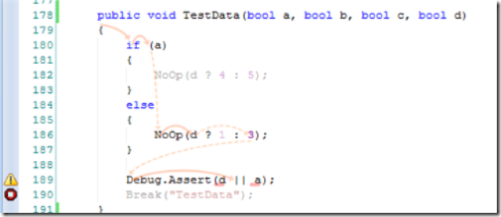
NStatic superimposes colored arrows directly on your source code showing the possible execution flows. Branches, loops, exceptions, and early returns are all visible at a glance — without leaving the editor.
Click any path to see the symbolic state at that point: what values variables can hold, what assumptions have been made, what exceptions could be thrown.
View examples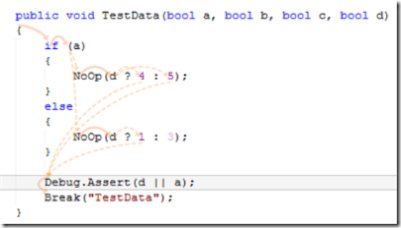
Loop Analysis
Loops solved, not simulated
Most analyzers give up on loops or unroll a fixed number of iterations. NStatic solves them to closed form.
A Fibonacci loop becomes a formula involving the golden ratio. An array-filling loop becomes a range assertion. Idempotent and involutive loops are recognized as patterns and eliminated entirely.
This means NStatic can reason about what a loop produces — not just whether it terminates.
How loop solving works →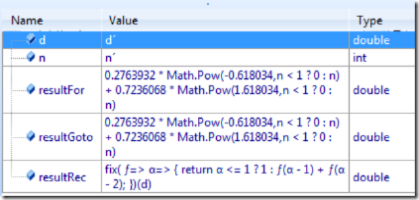
Interprocedural Analysis
Follows bugs across method calls
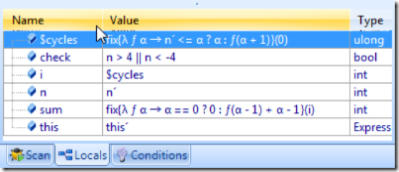
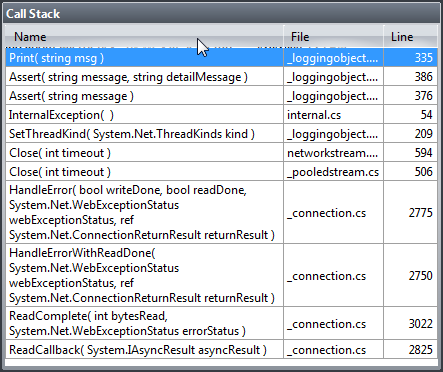
NStatic analyzes call chains up to 11 frames deep — including calls into .NET Framework library code, which it interprets directly from the IL (intermediate language) without needing source.
The call stack panel shows exactly which methods contributed to a finding, with symbolic values at each frame. No more guessing which caller passed the null.
How NStatic compares
Traditional static analyzers pattern-match against known bug signatures. NStatic reasons about your program mathematically — the difference shows up in what it can find.
| Capability | NStatic | FxCop / Roslyn | Resharper | Spec# / Code Contracts |
|---|---|---|---|---|
| No annotations required | ✓ | ✓ | ✓ | ✗ (requires specs) |
| Interprocedural reasoning | ✓ (11 frames) | Limited | Limited | ✓ |
| Loop analysis | ✓ Closed-form | ✗ | ✗ | Requires invariant |
| .NET Framework IL interpretation | ✓ | ✗ | ✗ | ✗ |
| Execution path visualization | ✓ In-editor overlay | ✗ | ✗ | ✗ |
| Symbolic assumption tracking | ✓ | ✗ | Partial | ✓ |
| Works on existing code | ✓ | ✓ | ✓ | ✗ |
Transparent Reasoning
Show your work
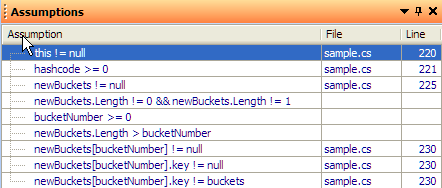
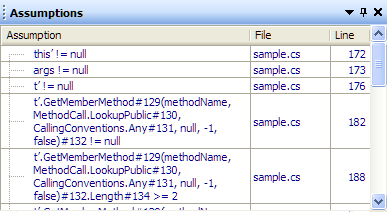
Every finding comes with a full audit trail. The Assumptions panel shows every condition NStatic has recorded as it traversed your code — what it knows about each variable at each point.
When a bug is flagged, you can trace back through the assumption chain to see exactly which inputs or conditions lead to the problem. The analysis is never a black box.
Be first to know when NStatic ships
NStatic is currently in pre-release. Leave your email and we'll notify you when the Visual Studio extension is available.
No spam. Just a single email when it's ready.